USSD Explained: How African Businesses Use Unstructured Supplementary Service Data in 2026
USSD (Unstructured Supplementary Service Data) is the session-based GSM channel powering banking, mobile money and self-service for billions of African phones in 2026.
If you build digital products for Africa, you cannot ignore USSD. While smartphone penetration is rising, the GSMA estimates that hundreds of millions of consumers across Sub-Saharan Africa still depend on feature phones or low-bandwidth connections in 2026, and even smartphone users routinely fall back to USSD when data is patchy. Mobile money giants such as M-Pesa, MTN MoMo, Airtel Money and Orange Money still run the bulk of their daily transactions on USSD shortcodes. For a CTO, product manager or growth lead serving African customers, USSD is not a legacy curiosity. It is a primary distribution channel.
This guide explains what USSD is, how the protocol works end to end, why African businesses keep choosing it in 2026, and how your team can launch a production-grade USSD application on HelloDuty without writing telecom code.
What is USSD?
How USSD works
Why USSD still matters in 2026
Business use cases for USSD
How to build a USSD application without coding
USSD compliance and pricing in Africa
FAQ
Get started with HelloDuty USSD
What is USSD?
USSD, also called "quick codes" or "feature codes," is a GSM-based communication protocol that sends short, session-based text messages between a mobile phone and an application running on a mobile network operator (MNO). A USSD command starts with an asterisk (*), is followed by one or more digits, and ends with a hash (#) — for example *334# for M-Pesa on Safaricom or *182# for MTN MoMo Uganda.
Unlike SMS, which is a store-and-forward channel that delivers individual messages, USSD opens a real-time session between the handset and the application. A single USSD message can carry up to 182 alphanumeric characters and round-trips typically complete in under a second, which makes the channel ideal for menus, balance checks, OTPs and short transactional flows. Sessions are stateless from the network's perspective: the application server is responsible for remembering where the user is in the menu tree.
How USSD works
A live USSD interaction has four moving parts: the handset, the MNO's USSD gateway, the USSD gateway or aggregator, and the business application. Here is the typical sequence:
The customer dials the code. For example, a Safaricom subscriber dials *334# to access M-Pesa. The MNO's network identifies the code as USSD and routes it to the USSD switching center.
The MNO forwards the request. The USSD gateway forwards the session to the registered service provider (a HelloDuty-style aggregator or a bank's in-house gateway) over a secure interface.
The application responds. The application server reads the input, looks up the customer's session state, and returns either a menu (a USSD menu) or a final response. Menu responses keep the session open; final responses close it.
The customer chooses an option. Each keystroke is sent back through the same chain. The session continues until the user finishes, cancels or the network times it out (usually after 90 to 180 seconds, depending on the operator).
Why USSD still matters in 2026
There are three structural reasons USSD is not going away in Africa any time soon:
Universal handset reach. USSD works on every GSM phone ever sold, from a $15 feature phone to the latest flagship. It does not require a data plan, an app store or even a recent OS.
Cost. A USSD session is cheaper than mobile data for the consumer and cheaper to deliver than a push notification stack for the business. For low-margin sectors such as agritech, microfinance and informal commerce, that economics matters.
Trust. Banks and MNOs have spent two decades training African consumers to trust shortcodes for money movement. That trust does not transfer instantly to a new mobile app.
Business use cases for USSD
If your buyer is a bank, lender, insurer, agritech, e-commerce platform, government agency, NGO or last-mile distributor in Africa, USSD probably belongs on your channel map. Common deployments include:
Banking and mobile money. Balance enquiries, mini-statements, airtime purchase, P2P transfers, bill payment, loan applications and repayments. Most African retail banks now ship a USSD shortcode alongside their mobile app.
Insurance. Microinsurance enrolment, premium payment confirmation and claims notification, especially for mass-market policies sold to low-income consumers.
SIM and account self-care. Customers reset PINs, swap bundles, top up airtime and request PUK codes through MNO-published USSD codes.
Retail and payments. Supermarkets such as Naivas have used USSD-based pay systems for fast in-store checkout.
Bookings and reservations. Movie tickets, bus seats, hotel rooms and event passes can all be issued through a USSD menu with mobile money settlement.
Surveys, voting and government services. Election commissions, ministries and research firms use USSD to reach hundreds of thousands of citizens cheaply and instantly.
Marketing and loyalty. Promotions, competitions and loyalty point lookups that reward consumers for engaging through a memorable shortcode.
How to build a USSD application without coding
Historically, launching a USSD application meant negotiating directly with each mobile operator, integrating against proprietary protocols and writing your own session manager. HelloDuty collapses that into a no-code, drag-and-drop builder.
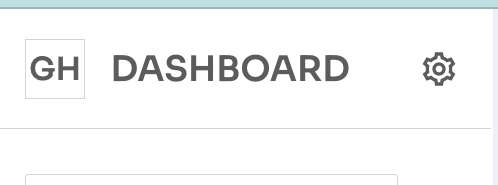
Click the gear icon and choose New USSD Flow. Name the flow after the product or campaign it serves.
Drag a Menu Action onto the canvas, name it (for example, "welcome"), set the response type to value with options, and configure the menu items the customer will see.
Add child actions for each option: API calls into your core banking or CRM, conditional branches, mobile money STK push integrations, or capture steps for names, IDs and amounts.
Click Run to simulate the experience on a virtual handset and validate every path.
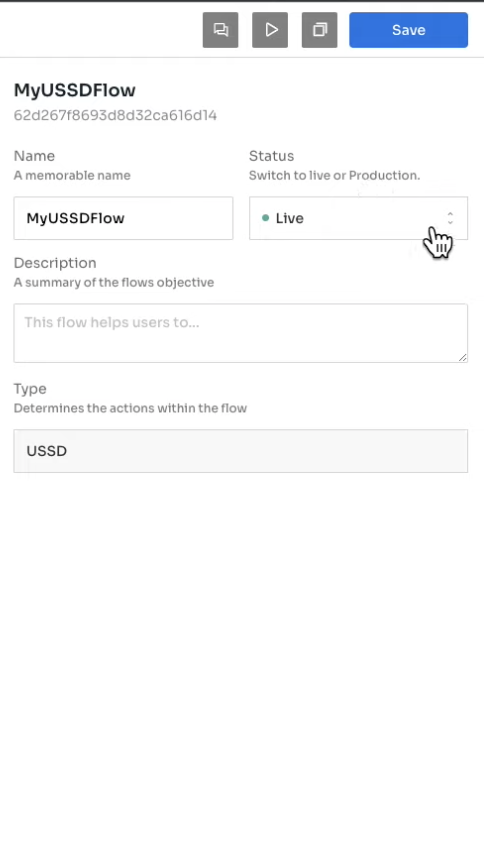
Once you are satisfied, set the flow to Live. HelloDuty maps it to a dedicated or shared shortcode on the operator(s) you have provisioned.
For developers, HelloDuty also exposes a REST API and webhooks so you can host menu logic in your own application and treat HelloDuty as the carrier-grade transport layer.
USSD compliance and pricing in Africa
Each African MNO publishes its own USSD pricing model, typically a fee per session segment or per minute of session time. In Kenya, the Communications Authority sets ceiling tariffs for USSD-based mobile money transactions; in Nigeria, the NCC has issued guidelines on end-user pricing and revenue sharing between banks and MNOs. HelloDuty handles operator onboarding, code allocation, billing and compliance paperwork on your behalf so your team can focus on the customer flow rather than the carrier contract.
FAQ
Is USSD secure enough for banking and payments?
USSD sessions are encrypted between the handset and the MNO using the standard GSM signalling stack, and modern deployments add application-layer authentication (PINs, OTPs, device binding). Almost every African bank uses USSD for at least balance enquiry and PIN-protected transfers.
What is the maximum length of a USSD message?
182 alphanumeric characters per message segment. Long flows are usually paginated across multiple menu screens.
How long does a USSD session last?
Most operators time out sessions at 90 to 180 seconds of inactivity to free up network resources.
Can I use USSD across multiple countries?
Yes. HelloDuty supports USSD codes in Kenya, Uganda, Tanzania, Rwanda, DRC, Ghana, Nigeria, Namibia, Malawi, Zambia and South Africa, and most of our enterprise clients run identical flows in two or more markets.
USSD vs SMS vs WhatsApp — which should I choose?
USSD wins for fast, session-based interactions on any handset. SMS wins for asynchronous alerts and OTPs at scale. WhatsApp wins for rich, conversational engagement on smartphones. Most modern customer journeys combine all three.
Get started with HelloDuty USSD
As seen above, USSD is the workhorse channel for African banking, mobile money, microinsurance and self-service. Whether you are a digital lender extending USSD-based M-Pesa loan flows, a fintech building on top of the M-Pesa application stack, or an enterprise rolling out a complaints menu on Safaricom, HelloDuty gives you a single platform to design, deploy and operate the channel.





.png)


.png)



.png)
.png)









.png)

.png)


